By Elaine Lembo
A never-ending view of the dramatic expanse of earth and water from an elevation of 30,000 feet gave Jim Freeman the big picture about how he wanted to spend his retirement.“Looking down on and landing at many of the Southeast Alaskan cities over a 32-year career really created the urge to one day boat in those waters,” says the retired Alaska Airlines pilot, a 1974 graduate of the U.S. Naval Academy in Annapolis, Maryland, and experienced yachtsman.
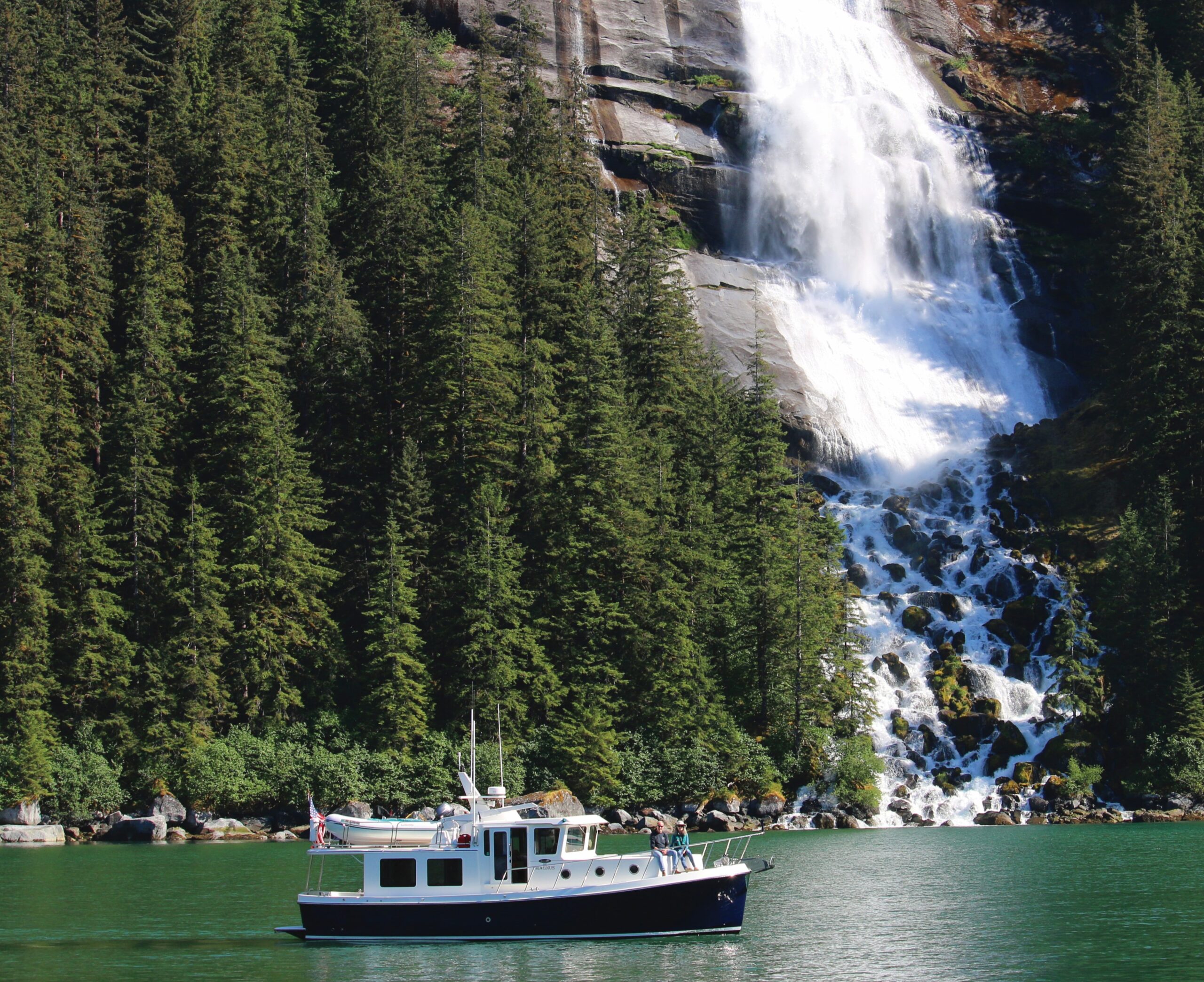
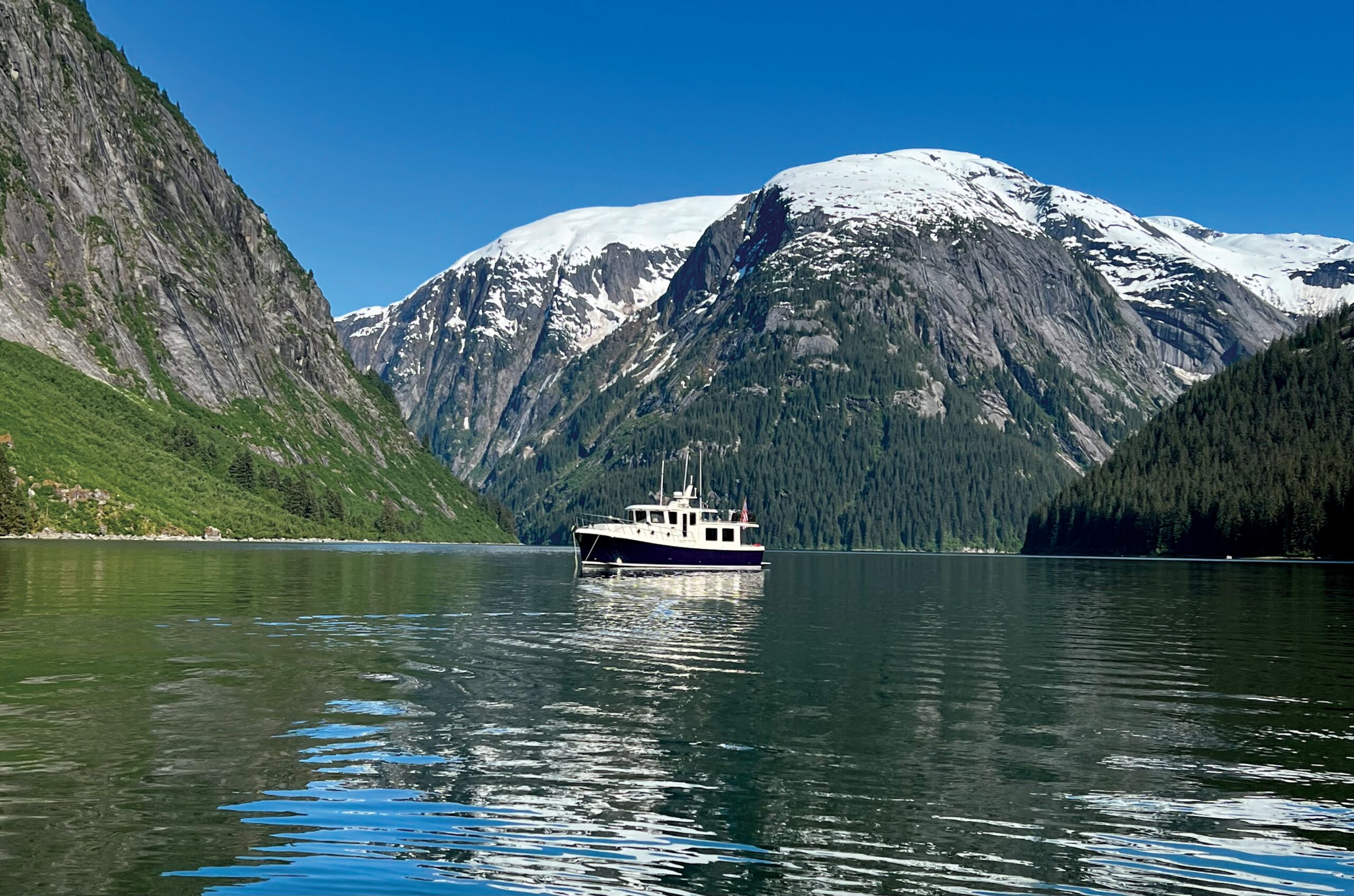
Magnus, the American tug 395, he and wife, Lynn, launched in 2011, gave “us our boating freedom with its comfort, range, capability and a touch of speed when needed,” Freeman says. The beefy rig sports a midnight blue hull with upper deck davit, beefy hardware, a hardwood sole and a single Cummins QSB-380 engine to handle cruising speeds up to 14 knots, while burning about two or three gallons per hour.
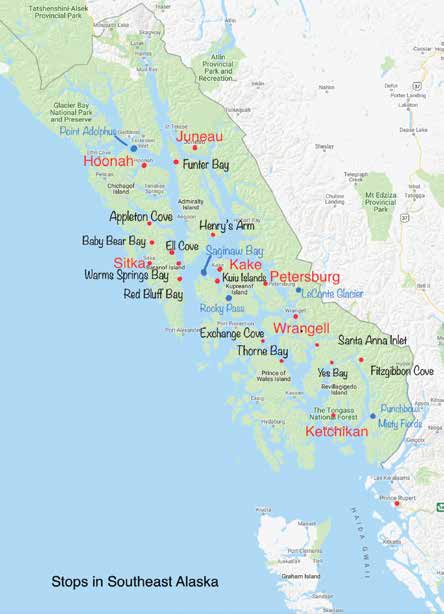
Aboard this perfect platform with a homeport of Anacortes, Washington, the Freemans have set out over the surface of the planet instead of above it, through the straits and steep inlets of Alaska’s ABC islands of Admiralty, Baranof, Chichagof and beyond. A bit closer to home, they’ve also enjoyed exploring the central coast of British Columbia, Canada, gravitating toward the waters between Cape Caution and Prince Rupert for their remoteness and the ability to anchor alone frequently.
“As we head north it is often that we see and find scenes that a camera just cannot adequately portray,” Freeman says. “Alaska is the ultimate journey for a small boat with the ultimate experience in beauty and wildlife. As a boater it was and is in our minds the ultimate adventure.”
The Road to Now
Jim Freeman grew up watching crop dusters spraying fields around the family farm in northern Georgia. He also watched a lot of WWII movies. “That’s what got me started,” he reminisces. “Annapolis offered good options at graduation and seemed a great adventure as I was ready to leave home. I could fly, go surface line, submarines or marine corps — all seemed interesting, but in the end, I was in flight school two weeks after graduation. I ended up choosing P-3 Orion submarine hunters instead of carrier jets. We had a crew of up to 14 at times and deployed to Bermuda, the Azores and Spain from our home base in Brunswick, Maine. It was a great adventure flying around the Atlantic and Mediterranean chasing Russian submarines.”
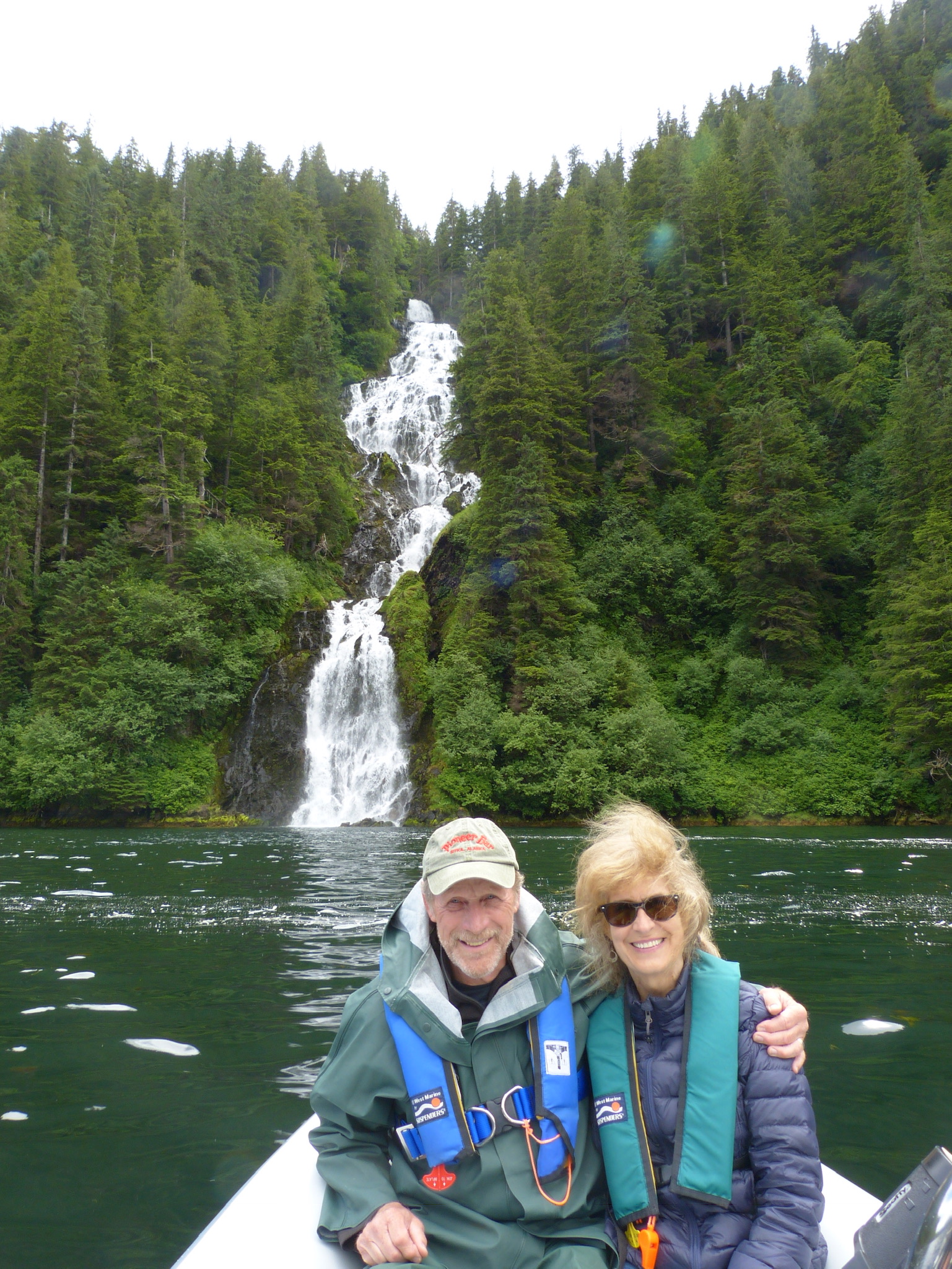
Five years after graduation, he wound up in the Pacific Northwest of the United States and started boating regularly, starting with a Bayliner, followed by an Arima, Wellcraft, and an Alaskan 46, which he powered north from San Francisco. After he and Lynn met, in 2001 they went to the next level aboard a Lindel 38. Lynn, from Washington state, was more than ready: She’d spent years at her family cabin by a small lake in the foothills of the Cascades boating and water skiing. Considered the voice of reason in the Freeman family, which includes seven grandchildren, over the years Lynn grew to love remote anchorages, where she and Jim would be the sole boat, and she was free to explore by kayak and to fish.
By 2011 the pull from Mother Nature on the couple intensified. “I was always pushing to try the next region or anchorage north to this area of indescribable beauty and at times fierce weather,” he says. “And Alaskan towns have a lot of character and charm. Alaskans just ‘get her done,’ which was a favorite saying of my airline buddies from Alaska. To do it right one needs to have a good cruising boat that is independent and capable of taking all the weather. You also need to be reasonably experienced and patient when you tackle the bigger waters.”
They’d started scoping out American Tugs years earlier; retirement loomed in 2016. At this point they’d cruised British Columbia for a decade, during which they’d become friendly with Duane and Lynn Duncan aboard the American Tug Emerald Star in the Broughton archipelago, off the northeast corner of Vancouver Island.
“At the 2011 Seattle boat show, we saw the new AT395 hull number one, and helping show the boat were none other than the couple from Emerald Star, now on their second American Tug,” he says. “Shortly after, with our boat on its annual haulout next to the factory, I decided to walk over to the factory and there was Magnus. The hull and house had not been mated yet, so we talked it over and since there was no one waiting for the boat, we decided to make the leap.”
Top Cruising Tips
Take care of the boat and it will take care of you.
“Make sure your boat is well-maintained and you are comfortable with its operation. Boathandling skills will be challenged in tight marinas with odd configurations when conditions turn windy.”
Be comfortable with your ground tackle.
“You’ll need to be confident and good at placing your boat where you want it. As for the type of anchor — use what works for you. We are pushing the anchor and chain limits with a 55-pound anchor and 400 feet of chain, but it suits us very well in some of the deep anchorages we find up north. We probably anchor out 80 percent of the time in summer months.”
Equip your boat with a watermaker.
“In summer, as you transit, water is scarce at marinas on occasion. It can also be sketchy. Taking extra jugs of water and bottled water is painful on a smaller boat. You don’t want to alter your itinerary to find a marina just to get water. Our saying is that with a watermaker, every day is a spa day. It really makes a difference.”
Do you have enough spares?
“Like talk about the best anchor, the spare parts discussion can be endless. We believe you can probably carry too many spares like you can have too many dishes or chairs or too much food.”
“Choose the critical spares that would alter your trip if you didn’t have them. For example, carry spare oil for a mid-trip oil and filter change. Include your zincs as well as they erode fast. A spare alternator is relatively easy to change and an essential component. Bring watermaker filters and any known issue spares for your model. Have a spare domestic water pump. Over the years and many boats, we’ve tended to favor keeping gadgets to a minimum. We go farther and carry less.
“There are the obvious spares you bring, like belts and engine/generator fuel and oil filters. If your raw water pump is old or dripping, consider changing it before a long journey. Don’t be afraid to handle a few mechanical chores on your own. Can you change an engine belt?”
Prepare some provisions ahead of time.
“We prep some meals and freeze them so they are ready to eat and we reduce the need for fresh vegetables. We also try to keep fishing simple too, using older methods that don’t require items like down-riggers.”
Stretch your legs in a different way.
“Going ashore [in Alaska] and taking a hike in many places just isn’t going to happen. It is wild and dense and there are bears and wolves. Kayaking or having Hobie pedalboard are great ways to get pictures from the water and exercise.”
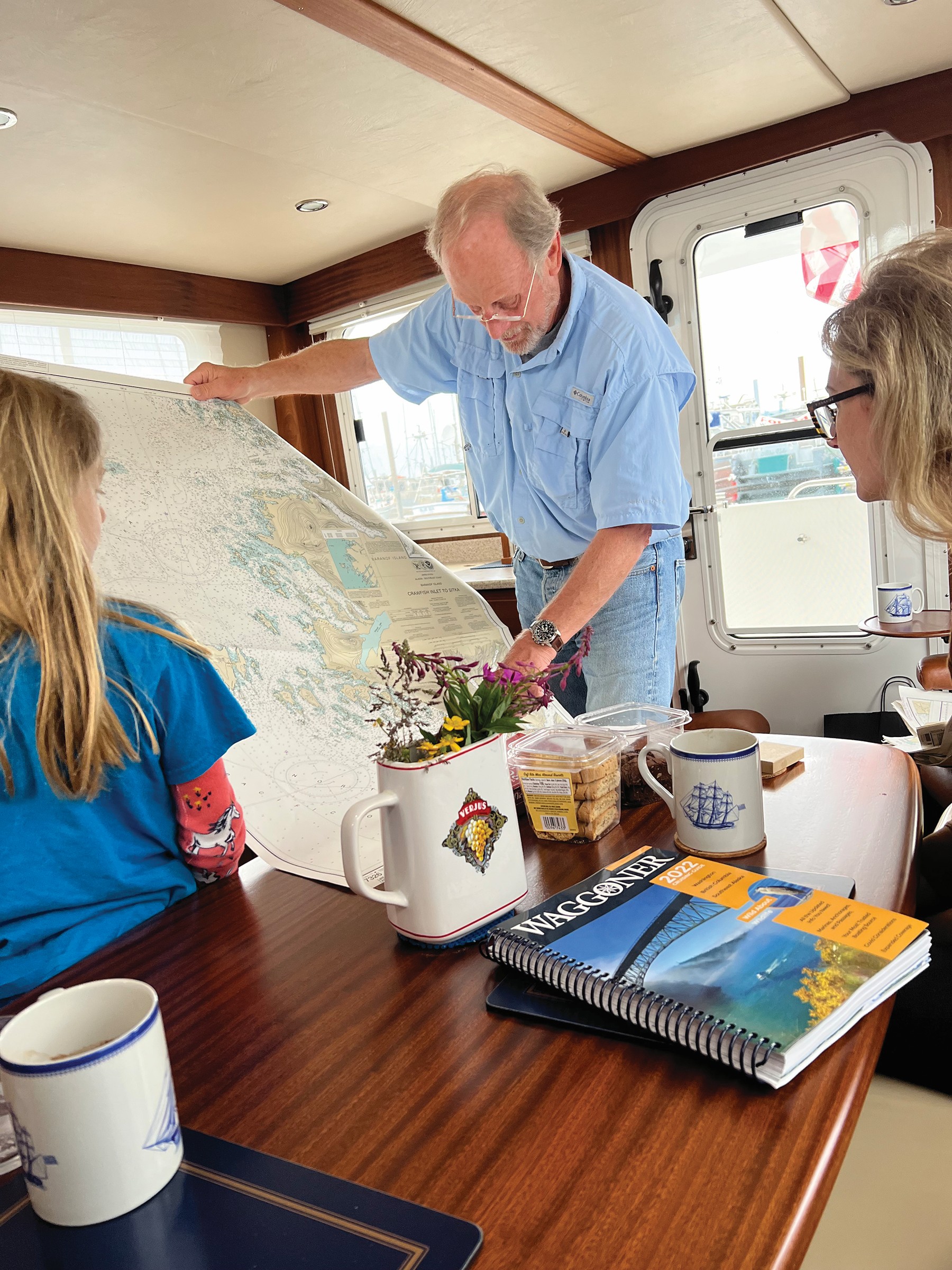
Don’t forget to pack a sense of adventure when it comes to charts and guides.
“In Alaska, charted depths are generally okay around more traveled areas, but depth surveys are old in many cases and even venerable cruising guides like Exploring the Inside Passage to Alaska warn about depths. Some of most fantastic areas require a sense of adventure and patience. I have seen uncharted rocks suddenly appear mere feet under our hull in 60 feet of water and realized that the current chart plotter and paper charted depths are much deeper than advertised. We sometimes anchor and then explore with the dinghy to chart a safe course into some lovely remote areas. Lynn has led me in on Magnus with the dinghy on a few occasions after a mapping expedition.”
Stay weather wise in real time.
“There are forecasts and then there’s what actually happens, and they are not the same on occasion. You can be paralyzed by analysis. Know your options and how to read the forecasts, which are for the worst conditions. We have sat for days waiting to cross Cape Caution and been rewarded. Later, when we catch up with much larger boats that went ahead, they confirm our choice.”
Don’t Rush.
“To do Alaska right and not wear yourself out, allow about three and a half to four months. This keeps you from rushing — which is never good — and allows you to linger an extra day or so at a good anchorage. Spreadsheets of destinations and hard dates at marinas, are not, in our opinion, the way to go. Do the research, know about your desires and have a general plan. Many marinas in Southeast Alaska will not allow reservations far in advance; like Sitka, you’ll be put on a list when you show up, and you might be anchoring for a day waiting for a slip.”
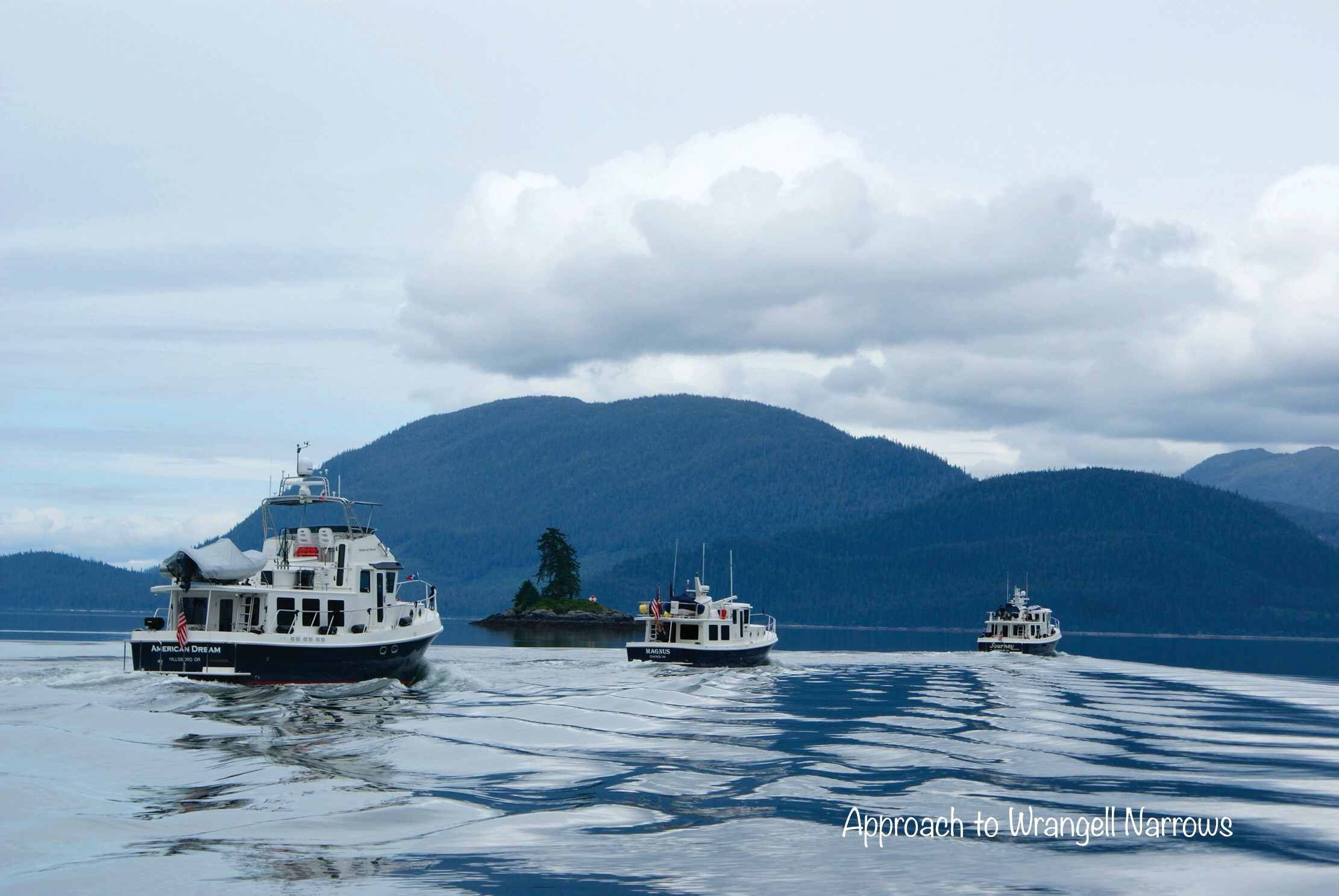
Since 2011, Magnus and crew have undertaken many extended voyages north, two of which have been to Alaska. The Freemans and Magnus have logged about 2,600 hours and a bit over 17,000 nautical miles, using about 6,500 gallons of fuel. Reflecting over how rig and crew have fared under the solo Freeman command, Jim says, “Getting the right mix of patience and adventure is important for a great experience, and not to mention, a happy crew.”